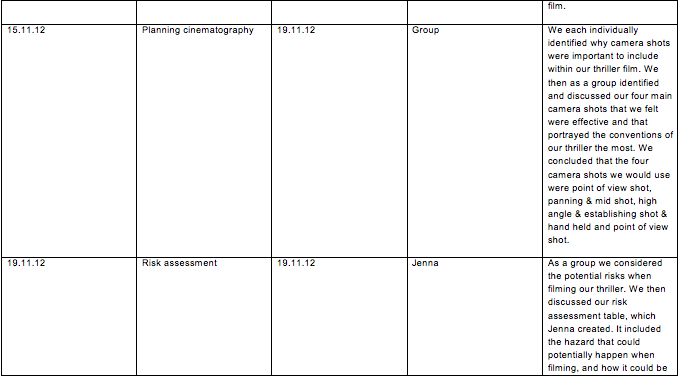
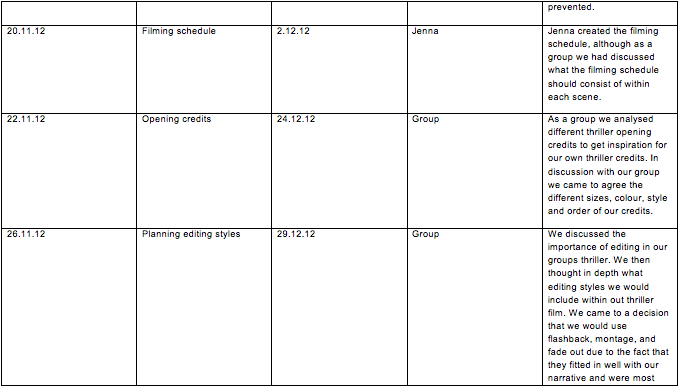
The general purpose of carrying out the meetings was so that our group had a consisted plan on what we were to do. Groups meetings consisted of logging discussions our group had week by week or in some case's daily to provide evidence that our group was planning through out the production making process in detail and that eventually the final process of the thriller would go according to plan. Overall I feel as that myself and my group worked extremely well as everone was able to input their own ideas which was all taken in consideration at some poit within the thriller production.
Monday, 14 January 2013
Monday, 3 December 2012
Planning sound track
Sound makes up most of our lives, if we couldn't hear sounds life would be very difficult as we couldn't communicate , hear music, films and television or even here for safety reasons for example hear when a car is coming etc. Sound is important within the make up of thriller films, as they create suspense and intensity to enable the audience and evoke different emotions about what is happening within the scene. For example themes and stings are shown in this era, as the different music themes produce different moods and feel for thriller films. Jumpy and quite scary music would make the audience feel left in suspense.
When deciding on what sounds to include with my groups thriller we will need to think about what will most keep the audience in suspense and making sure that it is conventional to our thriller genre. Below are some examples of sounds from http://ccmixter.org/ which our group felt would be most appropriate and conventional to have within our two minute thriller sequence:
Monday, 26 November 2012
Planning editing styles
Editing is one of the vital aspects in the process of film production which is generally used to provide coherence and continuity to a film. It is important as it works with
the raw footage, selecting shots and combining them into sequences to create a finished motion picture.
The following editing styles our group would like to include our thriller are flash back, montage and fade as i feel that they work well within my groups story line.
FLASHBACK- As a group we would like to use a flash back as one of our editing styles as within our story line an old lady has a flash back when looking at a picture of her daughter. This editing style helps the audience understand the narrative of our thriller as they know the relocation of time within the story line, or more accurately in our story line when the lady is looking at a picture of her daughter in which then the camera zooms into it and the audience see what happened at a time prior to that considered to be the story present.
MONTAGE- Montage was another style of editing which our group felt would be effective within our thriller. Montage is a series of short shots that are edited into a sequence, which is done to condense space, time, and information. It is used to suggest the passage of time which would be relevant to our story line when we want to switch from one location to another showing the victim being attacked and her mothers reaction knowing that she has.
FADE- We would like to use fade as one of our editing styles, it is a gradual transition from one image to another. we would like to use this when the unknown attacker turns of his torch light and the whole screen fades to darkness, like the same effect a light would have if it was turned off. This we hope will keep the audience in suspense and be left on a cling hanger on to what happened to the victim.
BLURR- Was one editing style we felt within our thriller. We would like to use the use of the blurr when the villain of our thriller if running through the forest, this would enable us to keep the villain unknown and in suspense as to who he is and what he is doing.
In conclusion these editing styles that we will include within our two minute thriller sequence will allow us to help make our thriller as conventional as possible due to the suspense the burr will deliver and the development of the audiences emotions though the editing style of the montage.
Friday, 23 November 2012
Planning camera shots
Camera shots are important to have with a thriller genre film as they help portray the narrative of the story and build suspense and tension to improve the viewing experience for the audience. It also allows the audience to have a greater understanding of a characters feelings and emotions, for example sympathizing for a victim who is being attacked, or feeling scared when they know the attacker is about to attack.
Four different camera shots
Point of view shot in shallow focus- We plan to include this shot within our two minute thriller at the beginning of our thriller where a woman is looking at a picture frame which is in her hands, this camera shot will be used so that the audience can see what the character is focusing, therefore making it conventional as is the first camera shot to create curiosity as to why she is looking at the photograph and what the story line could be about. It also creates tension as the camera comes closer and closer into the pictures face.
Panning and mid shot- This camera shot will be used to focus on the young girl victims face when she puts in her earphones, allowing her to be unable to hear what is going on around her. The use of this shot of her face makes sure that the audience are aware of as to what will happen as she will not be able to hear her upcoming victim, this therefore forebodes that something bad is going to happen which is a common convention in a thriller.
Close Up - A close up shot contains only a used weapon, some torn up clothing with blood on them and only a fairly small part of the scenes fills the screen. The use of this camera shot allows the audience to clearly see what has happened and forebode what will happen to our female victim which helps the audience to feel empathy for the character. Our thriller will use the close up camera shot a number of times though out our thriller, at the end of our opening scene when the female victim in lying on the floor and the camera shot focuses on her blood which the male villain has done. This shot will help make our thriller conventional because it allows the audience to build a relationship with the character and feel sympathy and empathy towards her, which is something the audience would expect to see from a thriller.
Hand held and point of view shot- we have chosen to us this shot when the victim is running away as she is starting to feel that someone or something is looking at her. The fact that the victim will be holding the camera will present a unsteady, jumpy, and jerky shot which create a sense of chaos and show that the victim is scared. This shot will be conventional to the thriller genre as the audience will emotionally connect with the victim and feel sympathetic and scared for her as they can see how scared and fast she is running, it also builds tension as to when what she is running from is going to appear.
The shots we have chosen to include within our thriller are all conventional to the thriller genre. The shots also we feel will be the most effective and allow the audience to connect with the charters as much as possible. Our target audience of
group storyboard
Once myself and my group had written our group narrative, Jenna and myself created the group storyboard which included pictures of each frame, time and information on the camera shots, location, iconography, lighting, actors, sound, editing, and narrative description which we want for each frame. By doing this, we were able to plan how we would like different scenes to be shown and presented in the finished film. We were able to decide how long we wanted each scene to last and what different camera shots we wanted to use and how we would link them to the next frame when editing. As a group we looked over and discussed our individual story boards which we had each created to come together and create our group story board. By looking at our individual storyboards it helped us compare which shots where more effective, and which story lines most fit into the thriller genre due to accurate conventions used. After analysing each story board we came to the conclusion that we would use Jenna's story line and most of the ideas within her story board, however some aspects from myselfs and sam's.


individual storyboard
As part of coming together with a final idea for my groups thriller, i created a storyboard to portray my ideas for a story line and different conventions i thought would be effective to include within our thriller. Below is evidence of my storyboard.
As a result in completing my storyboard I felt it enabled me to clearly portray my ideas to my group, as it specifically showed what I wanted to include in each frame, such as lighting, costumes, positioning of characters and so on. My group was also able to present their storyboards which allowed us to come together with a idea which we all felt was most effective due to the fact we was able to compare from each others.
Thursday, 22 November 2012
Opening credits
The purpose of film credits is so that the audience know the important member of the production such as the director and actors. Film credits are usually shown as text superimposed on a blank screen or static pictures, or sometimes on top of action in the show. There may or may not be accompanying music. They also give the audience a pre judgemental judgement on what genre the film is from the font or way the credits are laid out.
The colours used in the opening credits of the film se7en are dark mainly black, grey and white. These colours are used as the black contrasts with the white portraying that the hands of the person in the opening credits is mysterious. The style of the credits are white, thin and flickery, occasionally certain words being larger than others, to build up suspense. The use of genetic convention are used
the use of generic conventions of a thriller film - how can u tell is a opening to a thriller
the order of appearance
The sixth sense opening sequence
task 3- feedback
Subscribe to:
Posts (Atom)


