Friday, 8 February 2013

Audience Feedback

Audience feedback is essential to carry out as you are able to receive s the audience bring in the revenue and make a persons work credible, it is also what makes a film popular or not, audience feedback allowed me to easily analyse what the strengths and weaknesses of my thriller were. By carrying out audience feedback, I was able get different opinions from my target audience on my thriller, this is important as my thriller was created for what my target audience of 15 wanted .

Myself and my  group  screened our production in a West Hatch assembly in front of year 8's. The assembly consisted of  around 200 students including a few teachers.  we also posted our production on you tube once completed, by doing this it enabled us to gain instant online feedback, as it was easy to access from a range of different age groups from different people we did not know. This also helped us to further our research as to how  successful our thriller was.

I received both positive and constructive comments and these were;


Good comments

 ‘When the villain is running the camera shot is out of focus, which keeps the character
unknown. This suits a thrillers conventions, therefore keeping me in suspense’ -Nicole


Constructive comments
 ‘ Linking between shots could have been more fluent to make the film run smoothly’

-Michael McNeish.

 
‘Some shots should have been filmed with the tripod due to some unsteady shots’.

-Megan Gadd.


By reflecting on these comments I have discovered that i did create a successful thriller which did mostly suit the conventions my target audience would expect, especially in terms of the iconography and editing styles that was used.These comments have also allowed me to identify what improvements would need to be made next time to make my thriller production even more successful  if I could do this again, I would make sure that linking shots throughout the thriller would be more fluent. I would also use a wider variety of camera angle in order to keep the audience in suspense and engaged with the thriller production.


Monday, 14 January 2013

Group meetings


The general purpose of carrying out the meetings was so that our group had a consisted plan on what we were to do. Groups meetings consisted of logging discussions our group had week by week or in some case's daily to provide evidence that our group was planning through out the production making process in detail and that eventually the final process of the thriller would go according to plan. Overall I feel as that myself and my group worked extremely well as everone was able to input their own ideas which was all taken in consideration at some poit within the thriller production.

Monday, 3 December 2012

Planning sound track

Sound makes up most of our lives, if we couldn't hear sounds life would be very difficult as we couldn't communicate , hear music, films and television or even here for safety reasons for example hear when a car is coming etc. Sound is important within the make up of thriller films, as they create suspense and intensity to enable the audience and evoke  different emotions about what is happening within the scene. For example themes and stings are shown in this era, as the different music themes produce different moods and feel for thriller films. Jumpy and quite scary music would make the audience feel left in suspense.

When deciding on what sounds to include with my groups thriller we will need to think about what will most keep the audience in suspense and making sure that it is conventional to our thriller genre. Below are some examples of sounds from http://ccmixter.org/ which our group felt would be most appropriate and conventional to have within our two minute thriller sequence:


Monday, 26 November 2012

Planning editing styles

Editing is one of the vital aspects in the process of film production which is generally used to provide coherence and continuity to a film. It is important as it works with the raw footage, selecting shots and combining them into sequences to create a finished motion picture.


The following editing styles our group would like to include our thriller are flash back, montage and fade as i feel that they work well within my groups story line.


FLASHBACK-  As a group we would like to use a flash back as one of our editing styles as within our story line an old lady has a flash back when looking at a picture of her daughter. This editing style helps the audience understand the narrative of our thriller as they know the relocation of time within the story line, or more accurately in our story line when the lady is looking at a picture of her daughter in which then the camera zooms into it and the audience see what happened at a time prior to that considered to be the story present.


MONTAGE- Montage was another style of editing which our group felt would be effective within our thriller. Montage is a series of short shots that are edited into a sequence, which is done to condense space, time, and information. It is used to suggest the passage of time which would be relevant to our story line when we want to switch from one location to another showing the victim being attacked and her mothers reaction knowing that she has.


FADE- We would like to use fade as one of our editing styles, it is a gradual transition from one image to another. we would like to use this when the unknown attacker turns of his torch light and the whole screen fades to darkness, like the same effect a light would have if it was turned off. This we hope will keep the audience in suspense and be left on a cling hanger on to what happened to the victim.


BLURR- Was one editing style we felt within our thriller. We would like to use the use of the blurr when the villain of our thriller if running through the forest, this would enable us to keep the villain unknown and in suspense as to who he is and what he is doing.


In conclusion these editing styles that we will include within our two minute thriller sequence will allow us to help make our thriller as conventional as possible due to the suspense the burr will deliver  and the development of  the audiences emotions though the editing style of the montage.

Friday, 23 November 2012

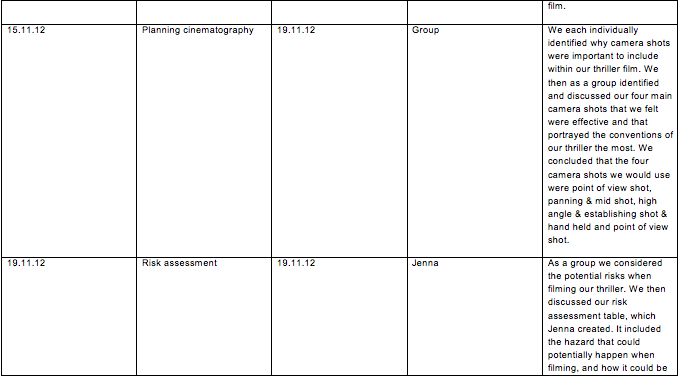
Planning camera shots

Camera shots are important to have with a thriller genre film as they help portray the narrative of the story and build suspense and tension to improve the viewing  experience for the audience. It also allows the audience to have a greater understanding of a characters feelings and emotions, for example sympathizing for a victim who is being attacked, or feeling scared when they know the attacker is about to attack.

Four different camera shots 

Point of view shot in shallow focus- We plan to include this shot within our two minute thriller at the beginning of our thriller where a woman is looking at a picture frame which is in her hands, this camera shot will be used
 so that the audience can see what the character is focusing, therefore making it conventional as is the first camera shot to create curiosity as to why she is looking at the photograph and what the story line could be about. It also creates tension as the camera comes closer and closer into the pictures face.

Panning and mid shot- This camera shot will be used to  focus on the young girl victims face when she puts in her earphones, allowing her to be unable to hear what is going on around her. The use of this shot of her face makes sure that the audience are aware of as to what will happen as she will not be able to hear her upcoming victim, this therefore forebodes that something bad is going to happen which is a common convention in a thriller.
Close Up - A close up shot contains only a used weapon, some torn up clothing with blood on them and only a fairly small part of the scenes fills the screen. The use of this camera shot allows the audience to clearly see what has happened and forebode what will happen to our female victim which helps the audience to feel empathy for the character. Our  thriller will use the close up camera shot a number of times though out our thriller, at the end of our opening scene when the female victim in lying on the floor and the camera shot focuses on her blood which the male villain has done. This shot will help make our thriller  conventional because it allows the audience to build a relationship with the character and feel sympathy and empathy towards her, which is something the audience would expect to see from a thriller.

Hand held and point of view shot- we have chosen to us this shot when the victim is running away as she is starting to feel that someone or something is looking at her. The fact that the victim will be holding the camera will present a unsteady, jumpy, and jerky shot which create a sense of chaos and show that the victim is scared. This shot will be conventional to the thriller genre as the audience will emotionally connect with the victim and feel sympathetic and scared for her as they can see how scared and fast she is running, it also builds tension as to when what she is running from is going to appear. 

The shots we have chosen to include within our thriller are all conventional to the thriller genre. The shots also we feel will be the most effective and allow the audience to connect with the charters as much as possible. Our target audience of 

group storyboard

 Once myself and my group had written our group narrative, Jenna and myself created the group storyboard which included  pictures of each frame, time and information on the camera shots, location, iconography, lighting, actors, sound, editing, and narrative description which we want for each frame. By doing this, we were able to plan how we would like different scenes to be shown and presented in the finished film. We were able to decide how long we wanted each scene to last and what different camera shots we wanted to use and how we would link them to the next frame when editing. As a group we looked over and discussed our individual story boards which we had each created to come together and create our group story board. By looking at our individual storyboards it helped us compare which shots where more effective, and which story lines most fit into the thriller genre due to accurate conventions used. After analysing each story board we came to the conclusion that we would use Jenna's story line and most of the ideas within her story board, however some aspects from myselfs and sam's.


individual storyboard

As part of coming together with a final idea for my groups thriller, i created a storyboard to portray my ideas for a story line and different conventions i thought would be effective to include within our thriller. Below is evidence of my storyboard.


As a result in completing my storyboard I felt it enabled me to clearly portray my ideas to my group, as it specifically showed what I wanted to include in each frame, such as lighting, costumes, positioning of characters and so on. My group was also able to present their storyboards which allowed us to come together with a idea which we all felt was most effective due to the fact we was able to compare from each others.

Thursday, 22 November 2012

Opening credits

The purpose of film credits is so that the audience know the important member of the production such as the director and actors. Film credits are usually shown as text superimposed on a blank screen or static pictures, or sometimes on top of action in the show. There may or may not be accompanying music. They also give the audience a pre judgemental judgement on what genre the film is from the font or way the credits are laid out.


The colours used in the opening credits of the film se7en are dark mainly black, grey and white. These colours are used as the black contrasts with the white portraying that the hands of the person in the opening credits is mysterious. The style of the credits are white, thin and flickery, occasionally certain words being larger than others, to build up suspense. The use of genetic convention are used

the use of generic conventions of a thriller film - how can u tell is a opening to a thriller

the order of appearance


The sixth sense opening sequence


task 3- feedback


Monday, 19 November 2012

Opening Scene Naritive

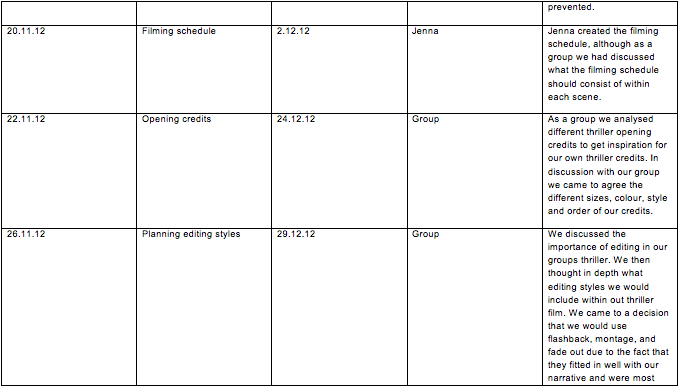
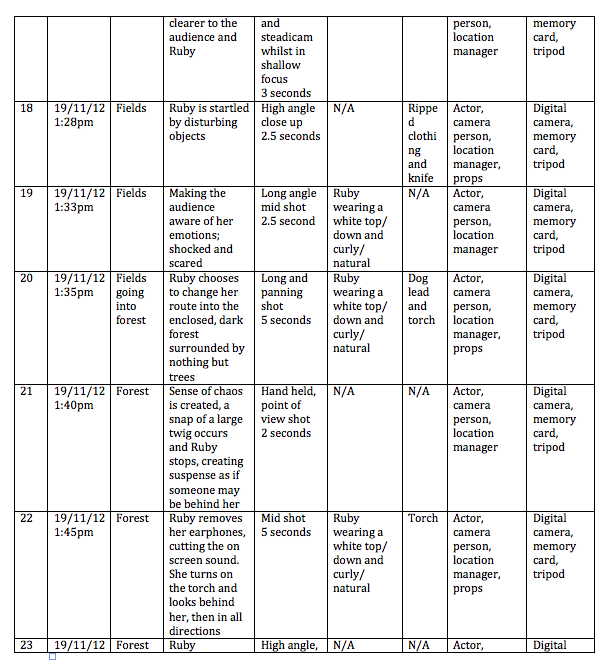
Filming schedule

A filming schedule is important to have as it gives myself and my group a clear outline on what our two minute thriller will include. Our filming schedule included specific things such as what each scene will include such as, location, date/time of the scene, shot type and duration, what the characters costumes will be and how their hair and make up will be done.It also includes the iconography within a scene, personnel and equipment we will be using. When we began filming our thriller the filming schedule gave us a strict guide and enabled us to stay on track due to the time limit we had. 

Our filming schedule is shown bellow:


Risk assessment

It is important to consider risks before filming as there are always chances of getting injured. As a group we discussed the potential risks which could happen within our group which are shown in the table below.


- how will the risk assessment assist you with filming?


- include your risk assessment


Risk Assessment
·       Why is it important to consider risks before filming?
·       How will the risk assessment assist you with filming?
·       Include your risk assessment

Film schedule
·       Why is a filming schedule important to have?
·       Did you follow the schedule while filming, or did you make any changes?
·       Include your filming schedule 

Monday, 12 November 2012

Character representation

Within a thriller it is important to have variety characters as it enables the audience to identify which character is the victim and which is the villain. By having a variety of characters it also makes the narrative more interesting due to the different characters stories. Representation of characters is also very important as it also helps the audience to identify which characters are which but also helps the audience to understand the purpose of the character within the narrative. For example a young female character, wearing white clothing would show that she is being represented as weak and young so therefore the audience would feel sympathetic towards her.

My groups thriller consists of three characters:


Villain
Name: Sam
Age: 31
Gender: Male
Race: White
Background: Unfound criminal, being looked for by police to arrest for previous assault and murder of young children. He is well known for being always one step ahead and covering up all evidence, leaving just the body behind. His choice of location is always deserted where the victim can be unheard and unlikely to be found.


Purpose of narrative: His purpose within the narrative is to kidnap and murder the victim ruby in the forest where she is walking her dog.

How will the character appeal to the audience: The villains identity is never revealed or shown throughout the two minute clip, however is portrayed to the audience as a villain.


Victim
Name: Ruby
Age: 14
Gender: Female
Race: Mixed
Background: A 14 year old school girl, brought up in a normal working  family.  She has a continuous routine that is watched by same on a daily basis, which eventually will cause Sam to kill her.
Purpose of narrative:  Ruby is the child that is kidnapped and killed by Sam, so therefore her purpose of the narrative is Sams victim.
How will the character appeal to the audience: Her character will be portrayed as an innocent, young child. The audience will feel sympathy towards her as her 


Name: Mum
Age: 35
Gender: Female
Race: White
Background: A normal, caring mother to  Ruby, they have a very close bond.
Purpose of narrative: On the day she is unable to attend the daily dog walk her and Ruby attend, so therefore Ruby goes alone. Before Ruby leaving she warns her to be careful, therefore foreshadowing the event that something bad is going to happen. whilst Ruby is on the walk  she receives a disturbed call, she rushes out straight away to find her. Ruby's phone and torch are found but she is not to be seen.
How will the character appeal to the audience:  The mother is portrayed as being very caring and lovin towards her daughter, the audience should feel s
ympathetic towards her as her daughter has been killed and was the closest person to her.


Friday, 9 November 2012

History of a thriller

Thriller is a broad genre of literature, film, and television programming that uses suspense, tension and excitement as the main elements.Thrillers heavily stimulate the viewer's moods giving them a high level of anticipation, ultra-heightened expectation, uncertainty, surprise,anxiety and terror.

Vox pops

My group decided to record 4 vox pops as another on of our research tasks, in order to gather some more primary research. Below is our recording of our 4 vox pops:


Recording our vox pops in all went extremey well as we selected four different people from a different age group and gender enabling us to get a variety of opinion just like the questionaire in the  previous research however in much more detail because the interveiwees were ables to expand on their answer instead of having to circle a specific one like in the questionaire.As a result in the group completing this task we was able to see what different age groups want to see when watching a thriller film which will help us in what to include in ours. We can also identify from these vox pops what is expected in thiller films which will hely my group establish what we should be putting and not be putting in our narrative in order to satisfy our audience and make it enjoyable.

Planning the mise en scene

As a group we decided our mise en scene location would be a forest and field in Theydon Bois, we choose this particular field as it is conventional to a thriller as it is deserted open area, with nothing but a train passing. It then leads onto an enclosed, dark forest surrounded by nothing but trees. This is conventional to a thriller as the victim is in a place where she cannot be heard. The only iconography are thriller use, is by the victim, who has nothing but a torch and phone that used before the attack and dropped during. This is a conventional to a thriller as the victim is in a deserted location and has no phone so therefore has a very slim chance of getting help. The villain therefore gains an advantage of being able to carry out an attack.

Our thrillers costume, hair and make worn by are characters will follow how other thrillers commonly portray theirs. The victim will be wearing white as her main colour as this will represent her innocence and purity. Her make up will be to a bare minimal and her hair will be tied back neatly, both features

costumes

iconography

facial expressions

positions of characters

lighting and colour


Thursday, 8 November 2012

production roles

camera operators- perform a vital role within the camera department on feature films. They support the Director of Photography, and the Director, by accurately carrying out their instructions regarding shot composition and development.

Actors- An actor communicates a character and/or situations to an audience through speech, body language and movement.


sound technician-  are required to assemble, operate and maintain the technical equipment used to record, amplify, enhance, mix or reproduce sound. sound technicians identify the sound requirements for a given task or situation and perform the appropriate actions to produce this sound.


editors- A film or video editor is responsible for assembling raw material into a finished product suitable for broadcasting. The material they work with may consist of raw camera footage, dialogue, sound effects, graphics and special effects. This is a key role in the post-production process and the editor's skill can determine the quality and delivery of the final product.


film director- This role is responsible for managing the creative aspects of a film, such as controlling what goes into the film plot, directs the actors and picking the location.


location manager-  are responsible for making all the practical arrangements for film or photographic shoots taking place outside the studio. one of their jobs are assessing scripts or story boards and scheduling them according to location


storyboard organiser- Storyboard Artists translate screenplays, or sequences from screenplays, into a series of illustrations in comic book form.


sam jenna me bonnie - actors

film director noone specific 
editors- all members of team 
location manager- jenna 
storyboard organisers- jenna and me 
sound tech all of us 
camera operators- jenna bonnie 

Thursday, 18 October 2012

preliminary task

The main purpose of this task was to test out our skills and knowledge for the first time by recording a short clip of Sam and jenna having a conversation and coming in from different angles. The task gave myself  and the group an insight on how to use the camera,and think about particular things which we would need to consider when creating our thriller such as appropriate locations, camera shots, character roles and if certain things are necasarrialy needed in a shot.

I found this task to be one of the most intersting so far as i was able to try out the editing programe which myself and my group will be using in the finishing touches of our thriller, i learnt what different things do what on the programe and how to cut certain parts of the recording we didnt need, and how to join camera shots together so it joins smothly rather than suddenly jumping to the next frame. I also learnt the different features on the camera and the correct settings for certain lightings. Being able to use the tripod with the camera also allowed me to see different camera shots which may be effective for my groups thiller film and how different shots help slightly when potraying a characters emotions or importance.

Below is my groups preliminary task:


Evaluation

As a group we decided to carry out a questionnaire which asked 10 different questions 


Write an evaluation to show your findings from your research into your target audience and explain how you will use your research to inform your planning.
·      What is the purpose of a target audience?
·      What types of research did you carry out and why?
·      How many people did you survey and why? 40
·      Were the vox pops successful and how will you with planning your thriller film?
·      Pick 3 different questions and discuss the results that you received. Explain how your results will assist you and your group with planning your thriller film
·      Were there any answers that you had to reconsider and why? 


Pie charts

As a group we decided to convey our newly found primary data in pie chart form as it was the clearest visual way we could portray our answers. It was also easy in which we were able to compare the most popular answer. The results from are questionnaire are shown bellow:


The fact that myself and my group have chosen to represent our data as pie chats will help us with our own group narrative as we are able to clearly see what is expected to be shown in a thriller to make it most enjoyable to watch to include within ours.

Questionaires

Questionnaires are very important when considering a target audience in that they give you a clear and accurate idea of what different age groups want to watch and what they don't want to watch. By caring out a questionnaire should give myself and my group an idea in what we should include within our thriller once decided on a target audience. shown below is the questionnaire my group created:

 My groups questionnaire
1) What gender are you?
Male Female

2) How old are?
12-15 16-18 19+

3) Which age certificate for a thriller film do you prefer to watch?
12 12A 15 18

4) What made you want to watch a thriller film?
Tv advertisements Recommendation Posters Other

5) What do you expect to see in thriller films?
Weaponry Flash backs Gore Death Other

6) What type of sound would you expect to hear in a thriller?
Tension building Horror sounds sound effects other

7) What characters do you like to watch in a thriller film?
One main character Group of people Young girl/boy Vulnerable woman

8) What do you find shocking in a thriller film?
Types of characters Plot Iconography (props)

9) Do you know the common plot for a thriller?
Yes No

10) What colour of clothing do you expect the victim and villain to be wearing?
Black/Grey and white Blue and pink Orange and green Purple and black


My groups questionnaire consisted of 10 different questionnaires on what they would expect or like to see in a enjoyable thriller film. All of the questions which were surveyed had a multiple choice which meant  it was quick for the people that we surveyed that and at the same time easy for us to see what people liked as they were specific answers. I have surveyed 40 people in total as it gives me a wide variety of people to get different opinions and views from randomly aged individuals allowing me and my group to have an idea of what the majority of people expect to see in a thriller  allowing us to put these conventions  and opinions people enjoy into our thriller knowing that people will enjoy it. As there are 4 people within are group we decided that each of us would survey 10 people each to fairly share out the work load. The task was very beneficial due to the fact that we had undertaken primary research meant that we was able to get accurate results that is recent and valid giving us a good insight in what people want to see in thrillers this present time.